
08/10Electronics
HAM Radio Repeater
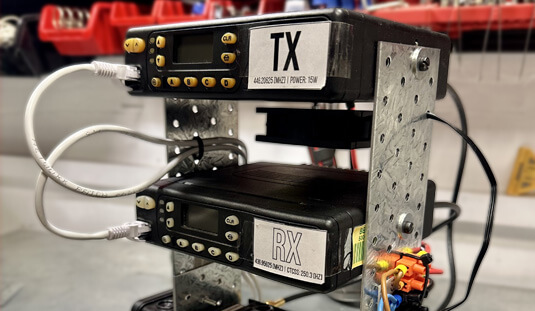
Duplex repeater system based on LGT8F328P and two Motorola GM650.
Idea
Amateur radio has been my passion since I was 16 years old. I have always been eager to try out the latest innovations in the world of telecommunications. I was the first in Poland to set up a simplex amateur radio repeater. Between 2009 and 2010, I built the Polish FRN (Free Radio Network), but I have always wanted to create a fully working duplex repeater with higher power. Over time, with increased financial possibilities, this project came to life, which ultimately exceeded my wildest expectations.
Technology stack
04 Arduino
 C++
 Eagle
 Fusion 360
At the heart of the system is an 8-bit microcontroller LGT8F328P (a slightly faster clone of Atmel's ATMega328P), which controls the logic of the repeater and plays additional messages in the audio line. The radios used are two trusty Motorola GM650 units that I updated to GM950 firmware, operating in the 70cm band and using FM modulation. For the duplexer, I used a device purchased and tuned from Aliexpress—exactly the same type that once formed the foundation of GSM repeaters around the world. The antenna connected to the repeater is a Diamond X300 mounted on a 5-meter mast. The entire setup is cooled by a single 20 x 20 cm fan.
Testing
Just as I wrote above the performance of the repeater exceeded my expectations. With a not-so-precisely tuned duplexer and an output power of 20W, the repeater can be heard within a radius of 100 km. Without much effort in locating the correspondent, the reports on both sides were 5, 9. The city where I live was so well covered that conversations could be held from a basement.
EchoRoom Application
It quickly became clear that a bridge was needed to connect walkie-talkie users with those who don't have any transmission-receiving devices. This led to the idea of the EchoRoom app, which enables conversations and the exchange of short text messages between walkie-talkies and, for example, mobile phones. More information can be found in the project preview in my portfolio.
Ditching Analog, Time for DMR
As the project evolved, I decided to leave analog behind entirely - the repeater now runs on the DMR system. I added a DMR Tier 2 modem (MMDVM) and wrote custom software to drive it. Along the way I built out a whole set of features, including a dashboard that shows the repeater's status in real time.
Going digital brought a whole range of benefits: GPS reports, targeted calls to a specific user or talkgroup instead of everyone on the channel, and two independent timeslots, meaning two separate conversations can now run at the same time without colliding with each other. On top of that, DMR supports RC4/AES256 encryption, adding a layer of privacy that was simply never possible with analog FM.
Beyond that, I added Mattermost notifications and a hardware display presenting live statistics and usage of the repeater.